My 12th May diary – a walk to Oughtibridge!

I have written this diary as my contribution to the Mass Observation Archive – they are calling on people all over the country, of all ages and from all backgrounds, to document everything they did on the 12th May 2020, as part of their social research and to provide records of what life was like during lockdown. http://www.massobs.org.uk/write-for-us/12th-may

I know this means that my contribution is no longer confidential, but the actual record that I send off to Mass Observation will be anonymous, so I suppose it’s fine to post it here! You can still take part in it yourself if you want to!

12th May Diary
img_20200512_110936

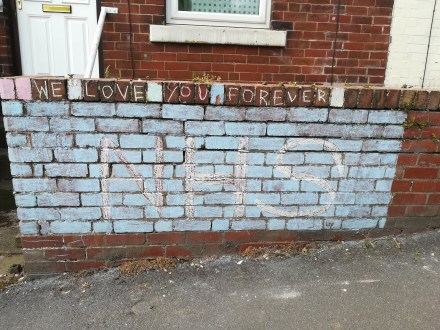
NHS chalk wall art in Walkley

On Tuesday 12th May, I wake up rather groggily next to my partner. He sleeps in for longer than usual too. He is currently furloughed from his retail job, and my work is currently over teatime and the early evenings so waking up earlier is more difficult. I am feeling more tired at times – I suppose it could be living with a constant undercurrent of worry and anxiety about the Covid 19 pandemic, although we are in a much better financial position than many other people.

I take a shower, washing my hair and shaving my legs. I’ve not been keeping up with that as often as usual this time in the year as there aren’t many opportunities to dress up! The weather is cool today with a mixture of clouds and sunshine – but at some point, I will get my legs exposed to some sun in my back garden!

I have some leftover apple charlotte I made last night for breakfast, with soya and coconut yogurt. I’m vegan and have been lucky that I’ve been able to pick up my usual veg box and extra food supplies from my local whole food shop, although rather than a browse around the shop, you now have to email your order a day in advance and pick it up from the shop’s carpark. It’s a good excuse for a walk, as well as my trip to our local small Asda with my partner on Wednesday mornings, to buy shopping for an elderly lady as well as for me. These small activities now count as major social events for me!

I make some cheese and lettuce wraps for lunch with some tortillas that have been lurking in the freezer for ages, fill a bottle of water and set off on one of my big walks. Since the lockdown started, I’ve been taking a longer walk once a week. The time limit on the lockdown rules was confusing – no one actually stipulated that it should be an hour maximum, so my solo walks have been several hours long, walking from my house and exploring new parts of Sheffield and the surrounding countryside. I have a full day off today, so I can take as long as I like.

Today, I start by walking the streets of Walkley, where I live, a suburb of Sheffield that expanded in Victorian times from a small village and a collection of farms. My route takes me along the streets that line the side of the Rivelin Valley, a mixture of terraced housing and pre-war semi-detached houses. It’s heartening to see the rainbows and teddy bears in the windows, and the messages and hop-scotch grids that children have chalked on the pavement. I reach the gates of Walkley Cemetery – a Victorian cemetery for the parish church, which is some distance away. As I walk downhill, enjoying the peace and wildlife, I walk into the woods and back into an adjoining graveyard, the Catholic Cemetery, which takes me down to the bottom of the Rivelin Valley.

I walk the short distance past weirs and the picturesque remains of old mills to Malin Bridge, where the Rivelin joins the river Loxley, which eventually flows into the River Don. It’s usually a busy traffic junction too, but it’s fairly quiet today. Still, it feels a little jarring to be in the “real world” for a few minutes, away from nature.

The path that runs into the Loxley valley looks very welcoming. I have walked a lot around here over the past couple of months. Sheffield has five rivers, four of them running into the river Don. On the west side of the city, the rivers are a popular way to walk into the Peak District or just to enjoy the wildlife. A century – or only a few decades ago – the rivers were busy with mills and factories, using the water power to grind cutlery and all sorts of other industries.

I reach one of the biggest mills, the former Hepworth Refactory, which made heat-resistant bricks, now standing empty and derelict. Bovis bought the site to develop housing there in 2006, but this was scuppered by local opposition and probably the financial crash. I turn up Storrs Bridge Lane which runs steeply up to Loxley Road. I can’t resist walking through the Heras fence surrounding the derelict Claremont House nearby. Once the grand residence of the factory owner, it later became the social club for the factory employees, but has been abandoned since the early 90s. It’s now a sad ruin, but I love taking photos of old ruined buildings, and enjoy the spooky feeling!

Checking my OS map, I cross the road and walk up a lane which carries on, very straight uphill. The lane is gated but is a signposted right of way, so I have to climb a stile which requires holding onto an iron bar to balance, so I apply hand sanitiser afterwards. The tarmacked lane diverts to a farm, but the path carries on, over another couple of stiles (more hand sanitiser), crossing another lane and up another steep old unpaved lane until I get to some woods – but the path still stays straight.

I glimpse my last view of the Loxley Valley and now I have a dramatic view into the Don Valley – I can even see huge steelworks in the far distance to the east, as well as conifer forests and Peak District moors. I could stick to lanes from this point onwards, but there is a tempting path that runs past a farm, marked “Sheffield Country Walk” – unfortunately, the path is set to take me into a field full of curious bullocks and a fierce-looking cow, but I just walk through one field instead and I’m back on the lane, heading into the village of Worrall. Worrall is much nicer than its name suggests – well-kept cottages and houses, a secondary school in one of the most picturesque settings you can imagine, a post office and several pubs. The pubs are all closed at the moment, but it would be a lovely place for a pub lunch and a pint – and a less exhausting walk with friends or family on a Sunday afternoon! An artist has placed a carved stone heart supported by the letters NHS at the crossroads. This village is so tidy that even the daffodil stalks have been tied into nice neat bundles.

I walk along pavements, then I take a path through woodland that takes me into Oughtibridge, a village alongside the river Don. I sit on a ledge near the bridge to eat my lunch and I’m surprised by a brown and white collie dog who shows a brief interest in my wrap before paddling into the shallows near the bridge to lap some river water. I’m definitely getting tired legs now and it takes quite a bit of effort to get up off the stone ledge and onto the path. The path along the river Don at Oughtibridge is lovely, shaded by trees from the ancient Beeley Wood. I pass dog walkers and families exercising and we exchange friendly greetings.

A high-pitched whine fills the air – I’m approaching the Abbey Forged Products factory. It’s a huge modern complex, which makes steel products for the oil and gas industry. It seems to be in full operation today. The factory is at the end of Beeley Wood Lane, which the path joins onto, and there’s a lot of litter on the roadside of this otherwise picturesque lane and evidence of fly-tipping, although it’s been softened in recent weeks by the spring growth: nettles, herb Robert, cow parsley and Jack-by-the-hedge, and I can still catch a whiff of wild garlic. I have fond memories of test driving my car here seven years ago, about this time of year and being surprised by how green and pretty it was.

Then Beeley Wood lane joins Claywheels Lane. I’m closer to home now, but the landscape is now a lot more industrial. As the river curves round and I see the Winn Gardens housing estate across the playing fields on the other side of the river, two children play on the weir, and I catch sight of a derelict factory with rusting corrugated iron and broken windows. I don’t know why I’m drawn to derelict places – I’m terrified of being in danger, so I’d never go inside anywhere like that, but I love wandering around and taking photos. I love the way that nature reclaims buildings, and I find beauty in decay. The site seems accessible from the road, across a ditch and I see a man in a hi-vis jacket duck through the trees and along the pavement, checking his phone. Is he a security guard, or has he been there to take pictures of the buildings? I am tempted to have a quick peek, but my legs are aching and I’m not too far from home now.

Soon, I pass familiar buildings, such as Fletchers bakery, with a lovely rainbow banner for the NHS and key workers, and the branch of Howden’s kitchens, where I bought my kitchen units from two years ago. We have been slowly renovating our Victorian terraced house, and we were supposed to be having our bathroom renovated in March – the work was cancelled due to the lockdown, but hopefully this will happen eventually! The Sainsbury’s supermarket, where part of Fletchers used to stand, is still open, and there is a steady stream of shoppers.

The Penistone Road junction is quite busy with traffic, but I turn right onto Leppings Lane, which seems much quieter. This takes me around the back of Hillsborough Stadium, home of Sheffield Wednesday. Hillsborough is such a big part of my life that it’s just an area of Sheffield – it’s where I work, shop and walk. However, to most people living outside the area, the Hillsborough disaster is the first thing that they think of. Not that I don’t think about it – there’s always a poignancy, especially as I pass the memorial on Catch Bar Lane – there are always bouquets of flowers and football shirts here. There’s a lovely tribute to the NHS and key workers on the gates of Hillsborough Primary School.

I walk down the beautiful lime Avenue in Hillsborough Park, which is busy with families and dog walkers. I now feel quite stiff but it’s a good feeling, knowing that I’ve probably walked further than anyone in the park today! It’s sad to walk past the chained-up playground, remembering the week before lockdown, when I last saw some of the learning disabilities clients from work playing here with my colleagues. I also think of the large annual festival held here, Tramlines. Last year, I saw Manic Street Preachers and Chic here, as well as volunteering to do wristbanding – which seemed like a bit too much like hard work at the time! Within a few days, the park was immaculate again. But such a huge gathering of people seems impossible at the moment. It’s been cancelled for this year. I hope that it can return next year – Hillsborough. Park is the main venue of the festival, but the free fringe part of Tramlines takes over the whole city. I was looking forward to going to some fringe gigs with friends and going with the flow this year, but that won’t be happening!

It’s eerie to walk down Middlewood Road, Hillsborough’s main shopping street, with all the shops closed and shuttered. The doors of the indoor shopping arcade are open and the lights are on in Home Bargains and the Boots Pharmacy, but the lights in the arcade are dimmed. It suddenly feels as if I’m in a disaster movie.

Now I’m on the final stretch of the journey after Hillsborough Corner – before the lockdown, this was one of the most heavily polluted places in Sheffield. I walk past the tram stop, the old swimming baths, now a Wetherspoons, the bus interchange, the Victorian Hillsborough barracks, which is now a Morrisons supermarket and a shopping centre, past the top of the street where I usually work and up through the Langsett Estate and the Grammar Street Park (created by clearing slum housing in the 1970s), until I’m back home again! My Garmin fitness watch shows that I’ve walked just over twelve miles today.

I tell my partner about the day’s adventures and relax with a can of cider in the garden. My legs are stiffening up rapidly and I seem to have pulled a muscle at the top of my left leg! I have a bubble bath while reading The Hunger Games by Suzanne Collins – I finally feel ready for reading something dystopian again, and then do some gentle yoga stretches.

I decide I’m not really fit for anything constructive this evening after that, so I heat up the pie I made yesterday – made with a few curry leftovers, an onion, red lentils and rehydrated soya chunks and a pastry topping, it’s a lot nicer than it sounds, and I roast a few stalks of asparagus from my veg box. I shred some lettuce with a spring onion and make a salad dressing with olive oil and vinegar. My partner tells me it smells terrible! I finish off the apple charlotte for pudding and then settling down to watching a DVD with a bit of knitting. We watch a couple of episodes of Jeeves and Wooster with Hugh Laurie and Stephen from the early 90s. They both look so young, but they are so funny, and just what I need after a long day of walking and a couple of long months spent worrying and being a key worker.

I’m back at work tomorrow teatime, and even though the long walk tired me out physically, it has been so good for my mind. I hope that when things get closer to “normal” again, I can show my family and friends the beautiful and interesting places I’ve discovered on my walks.


Red Rose Blues – a Tribute to Joe Ashton

This is my tribute to Joe Ashton: long-serving Labour MP, journalist, novelist and playwright – and one of my first writing and editing clients. He was diagnosed with dementia several years ago and sadly, he has passed away today. 

His daughter, Lucy, who is a journalist at the Sheffield Star, has written a wonderful tribute to her dad: Lucy’s tribute to her dad, Joe Ashton.

When I first became a freelance writer and editor, I met Joe Ashton, who wanted someone to type, edit and organise the second volume of his memoirs, Joe Blow, concentrating on his vivid memories of his childhood in 1930s Attercliffe and during wartime.

Working with Joe on his book was sometimes a frustrating, time-consuming process, with lots of chops and changes, but also with an excitement and enthusiasm about words. I learned a lot about writing and how to communicate from Joe. In the end, together, we produced a book to be proud of. Many people bought it when it went on sale in the Sheffield Star shop, and the proceeds raised hundreds of pounds for the Salvation Army, Joe’s favourite charity. Here is a taster for the book which was featured in the Sheffield Star in 2014: The Bread and Dripping Generation.

At first, not knowing much about dementia then, I wasn’t too concerned when he said he was “losing words”, but after a while, it was clear that there was something seriously wrong. I was working with people with dementia by then, so I could recognise some of the symptoms. I haven’t seen him for several years, due to the deterioration of his symptoms, but I always thought of him fondly.

During this Covid 19 crisis, my usual part time job working with people with learning disabilities has transformed into a different sort of care job, working with vulnerable older people in their own homes, several of them with dementia. I’ve naturally been thinking of Joe a lot for the past few days. Hearing the news of his death is something I’ve been expecting for a while, but particularly poignant to hear it on BBC Radio Sheffield’s lunchtime news today. Lots of love to Joe’s family and friends.

Joe Blow cropped

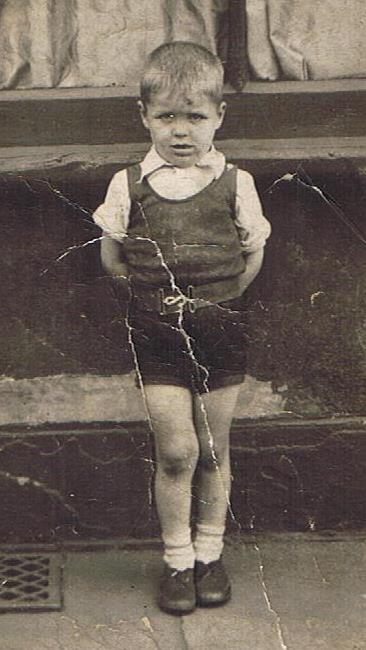
Joe’s favourite photo of himself as a child – rescued in a tin of family photos when the Ashtons’ house was fire-bombed in the Blitz. Copyright: Joe Ashton.


Red Rose Blues – for Joe Ashton


This is the story of a good Labour man,

With a bad case of Red Rose Blues.

Born in the back streets, knowing the price of coal

Was too high, in the hungry thirties,

In the smoke-black terraces of Attercliffe,

Where even the sparrows coughed,

And the kids shivered and starved.

In a city where the Don was empty of life,

He could find a spark of soul in anything,

Even in the Sodom and Gomorrah of the Blitz,

When he watched his house burn down,

And they rescued their wireless from the flames –

But left its hire purchase bills to burn.


As he rebelled against grammar school life

In the posh part of town, refusing to wear uniform,

He learned that words were tools, weapons, an escape hatch.

Writing down the bones; telling the truth;

Even lying through your teeth could make the world a better place;

A way of escaping outdoor lavs and tin baths for everyone;

Words could weave streets in the sky, a shiny new city,

And make them come true, in glorious Technicolour.


His heart was stolen by a red-haired, red-hearted girl,

Who matched him word for word through good times and bad.

Together, they fought for a better world,

And sometimes, each other. But there was always love;

It always ran deep in him, like the fire to keep fighting.


He was born with a wild mind, collecting the small details of life

Like garden seeds germinating in his pocket.

By old age, it contained lost streets, theatres and picture palaces,

Spiralling out of him like tendrils of bindweed,

Like the corners of his eyebrows,

While the words he reached for escaped him like racing pigeons.

In the end, he got lost in his dreams.

In his mind, he was always still a snot-nosed kid with a holey jumper,

Running through Attercliffe’s broken wartime streets

A pile of scuffed library books in his arms.


By Anne Grange.


75 Bodmin Street with Rag and Bone man cropped.jpeg

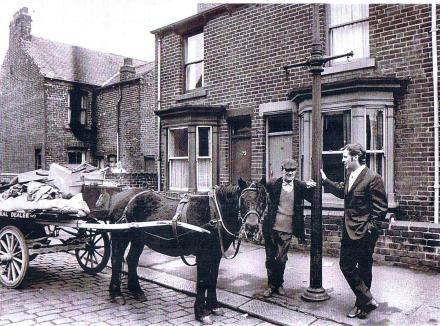
Joe Ashton as an MP in the seventies, revisiting the streets of Attercliffe and chatting to a rag ‘n bone man. Copyright: Joe Ashton.

Vegan Scouse Stew with Dumplings

img_20200319_202551

Scouse stew with dumplings

So far, I’ve been in a pretty privileged position when it comes to food in this crisis. I have always kept my kitchen cupboards well stocked with tins and essentials – I think it’s part of having been brought up by parents who were born at the end of World War Two and remember rationing. It’s a cushion against financial hardship.

I know that supermarkets have also been struggling with supplies of fresh fruit and vegetables, but I’ve been picking up my veg box from Beanies – they are closing their doors at the end of this week, but will still be open for orders and will be doing deliveries, so they are still going to be around.

By last Thursday, I didn’t have much fresh veg left, so I decided to make a stew. As it cooked, I wrote a poem about the fantastic cooking at the Ty Newydd Writers’ Centre in Wales, where I was due to spend a writing retreat this Easter, and it came out tasting just like Tony the chef’s speciality, Scouse stew, although my original inspiration for this comes from the traditional Nottingham home-cooking of my grandmother. I don’t suppose there’s much difference! It’s a tasty way of using up those sad looking vegetables at the bottom of the fridge.

Vegan Scouse – with Dumplings

Serves 3-4

Method and Ingredients:

For the stew:

1 soya-based veggie burger (I used Tesco own brand) – you could use soya chunks, or even make your own seitan – or maybe a handful of lentils or beans.

1 onion, chopped

1-2 carrots, sliced

1 parsnip, sliced

1-2 cloves of garlic – thinly sliced

2 smallish potatoes, cubed

Spices: smoked paprika, chilli flakes, cinnamon (to taste)

Mixed herbs

Vegetarian stock cube

Vegetarian Gravy granules

Salt and pepper

Method:

In a large lidded saucepan, sautee the onions and add the veggie burger. When the veggie burger has defrosted, chop it into 8ths – and then smaller pieces with your spatula. Stir well, then add the carrots, parsnips and potatoes. You can add different vegetables – whatever you have in the house! Then add the thinly-sliced garlic, mixed herbs and spices. Crumble in a vegetarian stock cube and three teaspoons of vegetarian gravy granules and add salt and pepper. Cover with boiling water until the vegetables are just covered – about 1.5 pints – about 800ml, should do it. Stir well, and leave to simmer on a medium heat.

For the dumplings:

50g vegetable suet (or you could use margarine)

100g self-raising flour

Water

Method:

Weigh the suet into a bowl, then add in the self-raising flour. Mix well, then add in approximately 75ml of cold water to form a firm dough. Knead for a few minutes, before dividing the dough into eight equal pieces, then roll each piece into a ball – you may need some extra flour for doing this.

Place the dumplings on top of the stew and put the lid on. Turn the heat down low, but keep it simmering. You might need to give it a stir from time to time.

Then sit at your laptop for at least half an hour while the stew cooks and the dumplings expand into fluffy masterpieces. You can write a poem if you like! I did!

Virtual Tŷ Newydd

If I inhale, I’m actually there,

Just before dinner time.

Tony has cooked up a treat.

Scouse, his signature dish –

Vegetables in a rich gravy;

Homemade seitan.

Chocolate cake for pudding.

Chatting to him earlier,

About his vegan recipes –

Taking a writing break;

A melt-in- the-mouth Anzac biscuit.


I settle back on the squashy white sofa,

Legs stretched out, balancing my laptop.

Facing the garden and the sea.

Fresh spring air fills the room

With the scents of spring;

The deep silence of the library walls

Letting in small, friendly noises –

Led Zeppelin leaks in from the kitchen speakers;

A gull cries as it crosses the hazy sky;

A blue tit chitters from sycamore tree branches.


The sea is a vague blue stripe that blends with the clouds;

The land on the other side of the bay is a wash of green.

Sometimes you can make out detail; houses, cars.

I know this view so well; the sea below the fields,

Past the sweep of the garden,

The copper beech; the magnolia in bloom;

The blackbird that hops across the lawn

Towards the giant chair.


I leave the laptop on the sofa;

Stand in the bay window to take in the view,

Under the echo that we play with while reading our work

To the others in the evenings, soft with wine

As the view fades into darkness.


I will return to this room,

I tell the echo.


Creative ideas for writing and reading for families in self isolation

Hi! It’s probably been the strangest week in history – so far! Now your kids have just come home and will be staying there…for a very long time. If you’re not a teacher, you might be totally stuck for ideas. How are you going to keep them occupied? How can you keep up their education? I really feel for the students doing their GCSEs and A-levels, and the uni students who are having to come home again.

I hope I can help in a small way! I’m a qualified English teacher, but secondary school teaching didn’t really suit me – hats off to those who stick with it. Instead, I worked in adult education, which includes encouraging families to learn in creative ways together, like den building and playing storytelling games. At the end of May, I was due to teach English at Bearded Theory festival’s award-winning festival school and also set up my library tent in the kids’ field. Hopefully this wonderful festival will still be taking place in September this year.

You might feel a bit daunted about the concept of teaching English, or Literacy, which it’s often called! This post isn’t about sticking to the rules of the National Curriculum. Hopefully, your child’s school will be providing resources for that, although my hints and tips should help to make it more enjoyable.

This post is about giving your kids, and yourself, the opportunity to fall in love with reading and having fun with writing. If your children are reluctant writers, don’t criticise their spelling or punctuation – just let them write and use their imaginations.

It helps if you show your love for creativity too. Read books, listen to audio books, have a go at some writing exercises – words are powerful and they can be a lot of fun!

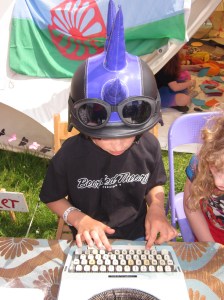
Give your children space to read and write. It doesn’t need to be quiet! At Bearded Theory festival, with the main stage booming away in the background, kids often spend hours reading books, and parents and kids curl up on a cushion and read together. My biggest draw, however, is my collection of vintage typewriters. I just tell children how to use them, and let them get on with it. This works amazingly well, with kids queuing up patiently for ages. Unless a child decides to write a novel…that has happened a few times!

The ideas below are set out into different age groups, but there are tips and links that will be useful – and fun to try – for children and adults of all ages in each section.

IMG_7512

Kids love typewriters!

Continue reading

Memoir Masterclass with Anne Grange – Webinar from the comfort of your own home!!!

This masterclass will now take place online as a Webinar, using Zoom. It will still be happening on Saturday 4th April 2020 at 1.30pm. Tickets are now only £10. So you can now take place from anywhere in the world, you’re also getting a great bargain! Booking details here: https://kurious.art/whats_on/webinar-memoir-writing-masterclass/20200404-1330-webinar-memoir-writing-masterclass

This masterclass has an added level of poignancy now. If you want to express your thoughts on the Covid 19 pandemic but are unsure where to start, this is the perfect opportunity. Personally, I’ve been finding my friend and writing colleague Beverley Ward’s facebook.com/keepcalmandcarryonwriting/ page and group very useful, with its daily writing prompts.

You can also find me at: https://www.facebook.com/AnneGrangeWriting/ if you have any questions, or on Twitter: https://twitter.com/anne_grange

I look forward to our afternoon of writing on 4th April! Get yourself comfy and have the following things near your computer screen: a notebook and pen (it can help the creative process to write or make notes in longhand) and an object that’s of sentimental value to you or something that tells a story about your life to use in writing exercises.

It will be a practical, creative masterclass, which will inspire you to write a fantastic memoir in any format – prose, poetry, for memoir writing for performance.

The Memoir Masterclass is aimed at people who want to tell the story of their life – or the story of a particular episode of their life. Maybe you know you have a great story to tell, but don’t know where to get started? I think we’re all going to have good stories about this unprecedented time of world-wide pandemic and mass communication.

In a supportive group, we will explore what makes a great memoir or autobiography. We will work on sparking memories, using “free writing” techniques to capture them. We will look at using poetry, prose and other techniques to capture memories, and using objects and photographs to help us to write our stories. The Memoir Masterclass will also look at structure, writing routines and will empower you to continue writing when you get home.

We will explore a variety of memoir writing techniques and genres, and you will actually start writing your memoir in the masterclass. The Memoir Masterclass will give you the confidence and support you need to tell your own story, in your own words.

About me: Anne Grange has been a freelance editor since 2013. As a freelance editor, she specialises in helping people to tell their own stories and enabling them to publish their memoirs and share them with the world, mostly working with self-published and indie authors.

Anne also works on community projects, such as the recent In Our Day project at Walkley Library, collecting the stories of people with dementia and compiling them into a fascinating book, documenting the colossal changes and challenges of ordinary people living in Sheffield in the twentieth century. She is an adult education tutor and experience course facilitator, specialising in creative writing and writing for wellbeing, and also works with adults with learning disabilities.

Storytelling is very important to Anne – whether memoir, fiction or through poetry, and as a novelist, she runs the Sheffield Novelists group which provides ongoing mutual support for novelists. Anne is the author of novels Outside Inside and Distortion.

Twitter: @anne_grange , Facebook: Anne Grange Writing.

To book a place on the Memoir Masterclass, visit the Kurious Arts website.

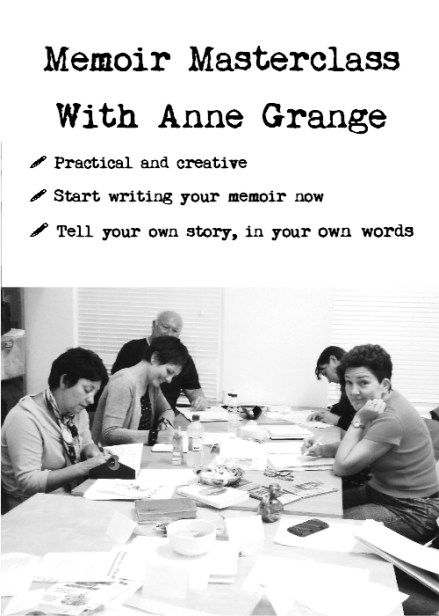
photo for Memoir Masterclass blog post

Free Sample of my novel Distortion

Hi!

Here’s a little present for you – a free sampler of my second novel Distortion. I hope you like it. If you do, please share it with your friends! The book is available online at: Buy Distortion here!

Here is the free sampler of my novel: Sample of Distortion by Anne Grange

new FINAL FRONT COVER

The brilliant front cover of Distortion, my second novel

Writing and Publishing Distortion – Advice for writers

I haven’t made a big song and dance about it…yet, but my second novel, Distortion, is now out as an e-book and a paperback. It’s been a long process, but my writing and editing skills have been sharpened by working with the inspiring clients I have worked with since 2013, when I set up my freelance editing business, Wild Rosemary Writing Services.

Now I have helped other people’s dreams of publication to come true, I felt that I knew the editing process well, I had great feedback from my friends who wee the “beta readers” of the book before it was published, and I had a wonderful cover designed by Susie Morley, which really makes the book eye-catching.

I started writing Distortion in 2010, shortly after finishing my writing MA, and it was wonderfully freeing to write something brand new, without any baggage or restrictions. Having new ideas and developing new characters was really exciting, and the second time around, I felt much more sure-footed when it came to plotting the novel.

Now I’ve written and self-published two novels, I can pass on some advice for aspiring novelists – I’d love to know what you think.

  1. Don’t work alone. Being part of a writing group is really useful. Find one that suits you, and if you can’t find one, form one yourself. I was one of the founding members of the Sheffield Novelists group, and now it’s been going since 2009, helping people through the creative process and bringing writers together. There are also many online writers’ groups, such as Scribophile. The ideal writers’ group will keep you going – e.g. help you to commit to writing a chapter per month, encourage you, but also discuss aspects of your work that could be improved.
  2. Keep going ! If you’re anything like me, you’ll have a million and one things in your life as well as writing a novel. Just keep going. Even if you can only commit half an hour in a day, or a few hours at weekends to your writing, keep up that commitment to yourself. This is something that you may keep needing to evaluate if you let yourself down, but that’s how I finished, and edited Distortion.
  3. Don’t hurry! In my opinion, a novel needs space and time to breathe and develop. You may find yourself being as influenced by your novel as much as you are creating it. For example, I thought that my music-obsessed teenage main character, Jason, might be really into the band Manic Street Preachers, so I started buying their albums, despite not being a big fan to start with. It had also been years since I had picked up a guitar. Along the way, I now have a “libraries gave us power” Manic Street Preachers tattoo (featured below), I’ve learned how to play the bass, and I’m now playing the guitar in a band. Your novel is part of you, so live and breathe it while you are writing. Obviously this would be a little worrying if you were writing a murder mystery though.
  4. Keep learning: go to writing workshops and spoken word nights whenever you can, read about and research the craft of writing, and meet fellow writers. Pop into your local library (hopefully you have one!), or search online for writing events near you. Often, there are events that are free or affordable, and there’s advice online. Go Teen Writers is one of my favourite blogs for advice on the nuts and bolts of writing, although it does tend to have a U.S. bias. This will also help you to build up a network of other writers and get great advice from published authors as well as people who are starting out.
  5. Edit as much as you can. Once you’ve finished the first complete draft, put it away for a few weeks at least and enjoy the freedom. Once your writing fingers start itching again, edit until your book is the best you can make it. There’s some good advice here about editing your book in layers.
  6. Once you’ve edited your book, you still need an external editor. This isn’t just a plug for my own editorial services! Whether this is someone that you pay, or a friend or relative you can trust to be eagle-eyed and even ruthless at times, you need someone to spot those silly mistakes (no matter how carefully you think you’ve checked your manuscript) or daft ideas that just didn’t work. Then go through the book again yourself, just in case anything stands out.
  7. Self publishing is difficult, but worth it. It’s great to get my words out in print and to know that people around the world can read them. The problem is publicity and marketing. I love my books, but I don’t want to feel like I’m blowing my own trumpet all the time and boring friends on social media and in real life to death by constantly reminding them to buy my book – and then to review it on Amazon. You’ve got to get the balance right. It’s a good idea to help out other authors too, particularly self-published ones. Give other writers good reviews and hopefully, they’ll do the same for you!

Please take a look at Distortion. If you fancy reading an exciting novel about secrets, lies and loud guitars, you’ll definitely enjoy it. It’s out as an e-book and also as a rather handsome paperback.

Here’s the blurb:

When teenager Jason Knight picks up a battered acoustic guitar in a charity shop, he just wants to form a band with his best friend Ben and stop being bullied by his nemesis, Bradley Smeed.

Jason’s guitar playing stirs up memories for his mum Kaz. She’s been keeping her true identity secret: fourteen years ago, she ran away from cult stardom in the band Mission Control, traumatised by the death of her lover, troubled guitar genius Daz Lightning.

Will Jason Discover the truth and become a rock god?

Read a sample or buy the book below!


Published in 2016 – Vivian Edwards by Chelle Martinez

This is the first erotic novel I’ve ever worked on, and I’ve really enjoyed it. Some of the books I’ve edited have steamy bits, but this is basically all steam!

It’s been an interesting challenge for me, but I would love to work on more projects like this. Who knows? This book might be the next Fifty Shades of Grey. It will certainly take you on a wild ride.

Vivian Edwards is hot off the press, in more ways than one. Based on Martinez’s true life adventures on the sultry island of Fernando, you’ll be thrilled, shocked and mesmerised!

Buy the book here in paperback and e-book.

front-cover-image

A sultry new read for fans of Fifty Shades of Grey

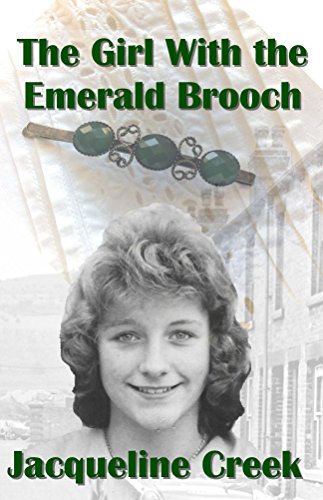
Published in 2016 – The Girl With the Emerald Brooch by Jacqueline Creek

2016 has been a busy year so far and I’ve been helping lots of authors reach their dreams of publication.

The Girl With the Emerald Brooch has been one of my biggest success stories to date. I first met Jacqueline Creek at a memoir writing workshop I ran in October 2013, as part of Sheffield’s Off the Shelf literary festival.

I asked participants to bring along an item of sentimental value to write about. Jacqueline brought along the brooch, a very small but significant object. The short but moving piece she wrote became the starting point of her memoir – and there will be several more volumes about Jacqueline’s exciting life to come.

Growing up in the working class community of Owlerton, Jacqueline looks after her ailing family and becomes a rebellious, rock ‘n’ roll loving teenager. Blossoming into a beautiful young woman, she faces the challenges of growing up and finding her own path in life.

This book is more than just a memoir. Jacqueline vividly brings the Sheffield of the 1950s and early 60s to life. She conjours up a long-lost world: Tanfield Road, where she grew up, has now been demolished and replaced by motor garages. I can’t drive down Penistone Road now without thinking about the people who once lived here.

After the book was self-published on Amazon, The Girl With the Emerald Brooch was published by J R Nicholls. The book is available on Amazon, in both paperback and e-book  formats.

The Girl with the Emerald Brooch. I can’t wait to start work on the sequel!

book-cover-photo


Be a Writer, See a Writer, Hear a Writer at Walkley Carnegie Library

For the past three years, I’ve played a major part in organising an event for Off the Shelf, Sheffield’s literary festival, which runs for three weeks in Sheffield throughout the city. Two years ago, I ran my own memoir writing course, and last year, I led a storytelling walk for families in the beautiful Rivelin Valley on a beautiful autumnal day.

Over the past year, I’ve become involved as a volunteer for Walkley Carnegie Library, my local library. Due to council cuts, many libraries in Sheffield now rely on volunteers to keep running. Ironically, because the volunteers are so passionate about the library, the range of events and services available is wider than ever, from pre-school storytelling, to knitting clubs and book sales. In March, I helped out at the launch of local bestselling author Gavin Extence’s new novel, The Mirror World of Melody Black. That gave me an idea. What about an event that showcased the talents of Walkley’s writers?

Walkley is an underrated suburb of Sheffield, in my opinion. The houses are mostly small terraces, sliding downhill towards the Rivelin valley on one side and the tram tracks running towards Hillsborough on the other, but there are some much larger older houses with huge gardens. All sorts of people live here – those who’ve lived in Walkley for generations, young professionals, families and students who appreciate a quieter life than they’d get down the hill in Crookesmoor. Yet, in May, the doors of many Walkley houses, big and small, open at the beginning of May for the annual Open Up event. Lots of artists live here, working hard in attic bedrooms and studios. There are lots of writers too, which I’ve realised by gradually meeting and chatting to people. Walkley is a hotbed of quiet creativity. We need to connect with each other, and encourage the new writers of the future.

Working with volunteer events co-ordinator Annie Bore, we planned an Off the Shelf event with something to appeal to writers and readers of all ages, and put in our funding bid to Off the Shelf, to start us on our way. We called the event “Be a Writer, See a Writer, Hear a Writer”, as people would get the chance to do all three during the course of the day!

Our funding bid was successful, so I contacted local writers and started planning the publicity. I’ve spent the last few weeks madly pinning up posters, tweeting, posting the event on Facebook and emailing everyone I know who is interested in creative writing. Back at the library, ticket sales looked slow. Late last week, I was panicking slightly. What if no one came? Would the writers I’d involved in the event be upset if no one turned up? Would the other library volunteers think I hadn’t planned the event well? In the end, the only thing to do was to keep spreading the word about the event, through word of mouth, emails, posters, and social media.

I woke up on Saturday morning feeling very nervous. I’d dropped the Usborne books for the book stall off the day before, along with my typewriter and decorations for the library, which made things easier, but as soon as we’d set up, the rain started pouring down outside. Throughout the course of the morning, only a few families visited the library. However, I did use my typewriter to write some lovely stories with children: one about a little girl helping some butterflies to fly home safely in the rain under her umbrella; and the other about an evil Spiderman battling Captain America and the Hulk. We also played giant scrabble and painted sparkly letters to be hung on a washing line around the children’s library. Young Adult author Sarah Dalton also joined us for the morning, and donated some books to the library.

The writing workshops went well, although I had been a bit worried about numbers. This gave me an excuse to join in with them, which was no problem for me! We had some amazing young writers from local schools, and a special mention must be made to a friend from Oxfam stewarding, who joined us all the way from Worcester for the day. Daniel Blythe gave us a masterclass in developing stories by using settings, and inventing characters using photographs and a “character map” to help us to plan. Creative writing is something that everyone should be able to do – not necessarily for a living! But it’s great to flex your imagination and develop new ideas. Daniel works regularly in schools to prove just that. In a world where some children think that the most important thing a story needs to start with is a capital letter, imagination can be a rare commodity.

Poet Rob Hindle inspired us to bring historical characters and events alive in poetry. We started off by imagining historical characters who didn’t quite make it, such as Shakespeare’s frustrated actor brother, who ended up as an “extra” in William’s plays, and the wife of Isambard Kingdom Brunel, who didn’t like tall hats. We read a selection of poems by Martin Espada and Eevan Boland that dealt with historical themes and characters before starting some of our own.

We each picked a photograph or painting from a historical scene, and Rob asked us a series of questions about the picture. We had to write descriptions of what was happening, details we didn’t notice at first; what sounds could be heard. Then we used our answers to construct a poem. It was a great idea, and we all came out with an interesting, dramatic first draft of a poem.

There was time for a quick trip home to eat, before heading out again for the evening event. The other library volunteers had organised everything really well – refreshments and room arrangements were all in place, and the only thing I needed to do was to help carry a few more chairs, as people kept arriving, and shortly after 7pm, the library looked like a real literary soiree!

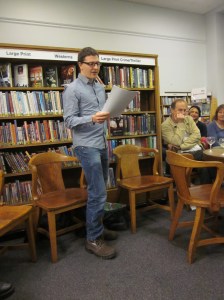
The open mic slot was fully booked, and we were treated to short excerpts of everything from humorous haiku, novel extracts, short stories, to poems about the black hole under the cooker where everything disappeared. Next, Fay Musselwhite, Chris Jones and other poets from Longbarrow Press enthralled us with poems about families, landscape and long journeys.

Folk musician Patrick Rose had the audience absolutely captivated with his songs – drawing on the folk traditions of the Childe ballads, and his own compositions, particularly ‘Paradise Square’, about a forgotten piece of Sheffield history. Patrick sang on his own and accompanied by his beautiful guitar playing, and we were spell-bound.

Finally, novelist Gavin Extence gave us an exciting exclusive extract from his third novel – the first time he’s shared any of it in public. We really enjoyed it, and when it’s a bestselling novel, like his previous books, The Universe Versus Alex Woods and the Mirror World of Melody Black, we’ll be able to say that we heard it first!

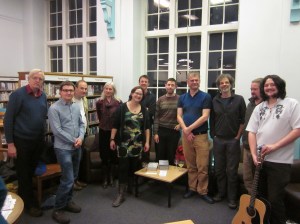
At the end of the evening, I was pleased and relieved that I’d pulled it off – I had organised a miniature literary festival! People really enjoyed it, and it gave a wide variety of writers a chance to perform their work. The experience of putting on an event is always nerve-wracking, but it’s also addictive. We’re already starting to think about other literary events that Walkley Carnegie Library could host, so watch this space!