
Hi! It’s probably been the strangest week in history – so far! Now your kids have just come home and will be staying there…for a very long time. If you’re not a teacher, you might be totally stuck for ideas. How are you going to keep them occupied? How can you keep up their education? I really feel for the students doing their GCSEs and A-levels, and the uni students who are having to come home again.
I hope I can help in a small way! I’m a qualified English teacher, but secondary school teaching didn’t really suit me – hats off to those who stick with it. Instead, I worked in adult education, which includes encouraging families to learn in creative ways together, like den building and playing storytelling games. At the end of May, I was due to teach English at Bearded Theory festival’s award-winning festival school and also set up my library tent in the kids’ field. Hopefully this wonderful festival will still be taking place in September this year.
You might feel a bit daunted about the concept of teaching English, or Literacy, which it’s often called! This post isn’t about sticking to the rules of the National Curriculum. Hopefully, your child’s school will be providing resources for that, although my hints and tips should help to make it more enjoyable.
This post is about giving your kids, and yourself, the opportunity to fall in love with reading and having fun with writing. If your children are reluctant writers, don’t criticise their spelling or punctuation – just let them write and use their imaginations.
It helps if you show your love for creativity too. Read books, listen to audio books, have a go at some writing exercises – words are powerful and they can be a lot of fun!
Give your children space to read and write. It doesn’t need to be quiet! At Bearded Theory festival, with the main stage booming away in the background, kids often spend hours reading books, and parents and kids curl up on a cushion and read together. My biggest draw, however, is my collection of vintage typewriters. I just tell children how to use them, and let them get on with it. This works amazingly well, with kids queuing up patiently for ages. Unless a child decides to write a novel…that has happened a few times!
The ideas below are set out into different age groups, but there are tips and links that will be useful – and fun to try – for children and adults of all ages in each section.
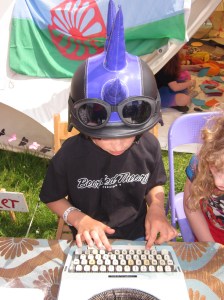
Kids love typewriters!
Creative Ideas for Preschool and Key Stage 2-aged Children
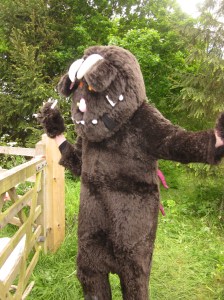
A friend volunteered to be the Gruffalo at the Bearded Theory forest school a few years ago!
Having fun with your preschooler is the best tip for having fun – concentrate on storytelling. Could you build a den for a Gruffalo? A fairytale castle? A few sofa cusions and blankets could be enough to spark a young imagination.
Tell stories together – you could start with a well-known fairy tale or a Disney film and encourage your kids to change the story – what if Cinderella had Doc Martins instead of glass slippers? You could even act out your stories, video them on your phone and send them to friends and relatives who might be feeling lonely and in need something to cheer them up. Children could invent a superhero to solve the world’s problems.
Dress up as different characters – you don’t need a proper dressing up box – improvise, as long as no one gets a saucepan stuck on their head!
Read out loud to your children and enjoy books together. If you run out of books, check online to see if your local library is still open or providing a delivery service.
In Sheffield, and in many other places, if you have a library card, you can sign up for many ebooks and audio books for all ages for free at with RB Digital, but you will need to sign up via your local authority’s library website. If you’re not already a member of a library, you can sign up online in many areas.
Creative Ideas for Primary Key Stage 2 School-Age Children
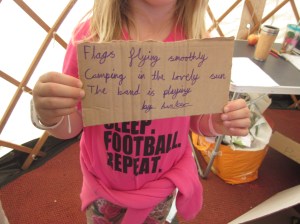
Haiku writing at the Bearded Theory school
I have discovered at Bearded Theory that kids enjoy writing in a different way. If you have an old typewriter or even an old word-processor that still works, drag it out and amaze your kids by telling them about a world before the internet! In my experience, once I’ve show a child how to use the typewriter and inserted a sheet of paper, they’re away and typing. Perfectionists sometimes find it hard to make mistakes and not be able to correct them, but most children really enjoy it! Perhaps because it’s a physical process.
Last year at Bearded Theory, I taught children how to write haiku poems and they got really excited about being able to write them in felt tip on pieces of cardboard! You could also experiment with feather quills or making letter stamps out of recycled materials.
Give your child the space and time to write what they want if that’s what suits them. If they need ideas or help, support them but don’t force them into writing a story if they’re not in the mood. Kidzone is a useful website with free resources which might help you to get started.
Pictures and objects can often stimulate creative writing. Pexelsis a great site for finding photographs and all kinds of images.
Playing word games together, such as consequences together as a family can be very funny. Writing limericks about each other is a good way for kids to learn how to write poetry while being very silly! Riddles really help to get those brain-cells working, and puns and other jokes are a good way for kids to learn spelling and grammar – shhh! Don’t tell them that! Your children might even want to put together a stand-up routine to entertain the family. Learning how to be funny is a very important skill. Here are some clean jokes for starters.
Enjoy reading together, just for fun – try reading a chapter of a favorite book every night as a family. If you have reluctant readers, try to reel them in with a film adaptation of a favourite book. One of my personal favourites has to be Wes Anderson’s adaptation of Roald Dahl’s Fantastic Mr Fox. Once they’ve seen the film, they might want to read the book!
Creative Ideas for Secondary School-Age Children
Children of this age are the most likely to feel anxious about pandemic, so encourage them to write about their experiences. Encourage them to keep a journal, or write down goals – things they’d like to achieve while they are in isolation and new skills they’d like to learn.
Maybe steer anxious teenagers away from the dystopian fiction and films, but it’s a great skill to be able to lose yourself as a book and to forget about the real world for a while. I’m currently enjoying the Wee Free Men series by Terry Pratchett – I’m not usually a huge Pratchett fan, but these books are perfect for me at the moment. Very funny, a fantastic, independent heroine in Tiffany Aching, and full of widsom.
As soap operas are going to be suspended due to the Corona Virus outbreak, drama addicts could have a go at writing an episode of their favourite soap, or even invent one of their own. The BBC Writers Room has some great resources and opportunities.
Here’s a post about grammar jokes and puns which is suitable for slightly older readers.
Creative Ideas for Adults and young adults
My writing friend and colleague Beverley Ward has started a Facebook page and group with daily writing prompts. Keep Calm and Carry On Writing. All the exercises would be suitable for trying out on your own, but you could try doing them as a family. One of the prompts so far has been to spend a few minutes in your house and garden, writing down what you can see, hear, feel, touch and taste. You can use it as a way of trying out writing – you don’t need to create a polished piece of poetry – just have a go.
https://nanowrimo.org/ NaNoRiMo stands for National Novel Writing Month and started out as a challenge for writers to write a novel in a month! It’s now really expanded its remit and has a free programme for young writers – and provides a supportive community of fellow writers.
If you or your teenager are keen fiction writers, I’ve been following this website for a while. https://goteenwriters.com/ Its advice on the craft of writing is excellent, and there are lots of free writing tools to explore.
To keep your reading material fresh, you could download the free Kindle app or check out Smashwords for ebooks as well. You might even end up publishing your own book after all this writing!
For adults and older teens on the intellectual or literary side, you can support an independent publisher and your local bookshop and buy a subscription from https://www.andotherstories.org/
 Anne Grange Writing